

Margin Notes: Alimony Sam
An inside look at my approach and processes, and some of the challenges faced


Release date: April 14, 2026
Hi, and welcome to the Margin Notes on Alimony Sam: The Man Who Wouldn’t Pay.

Today, I’ll be sharing a little about where I found this lost & found story, my over all approach to the story, some of the challenges I faced in piecing it together, and a bit of historical context that didn’t make it into the finished story.
So let’s, see what we find!
A folk hero in the making
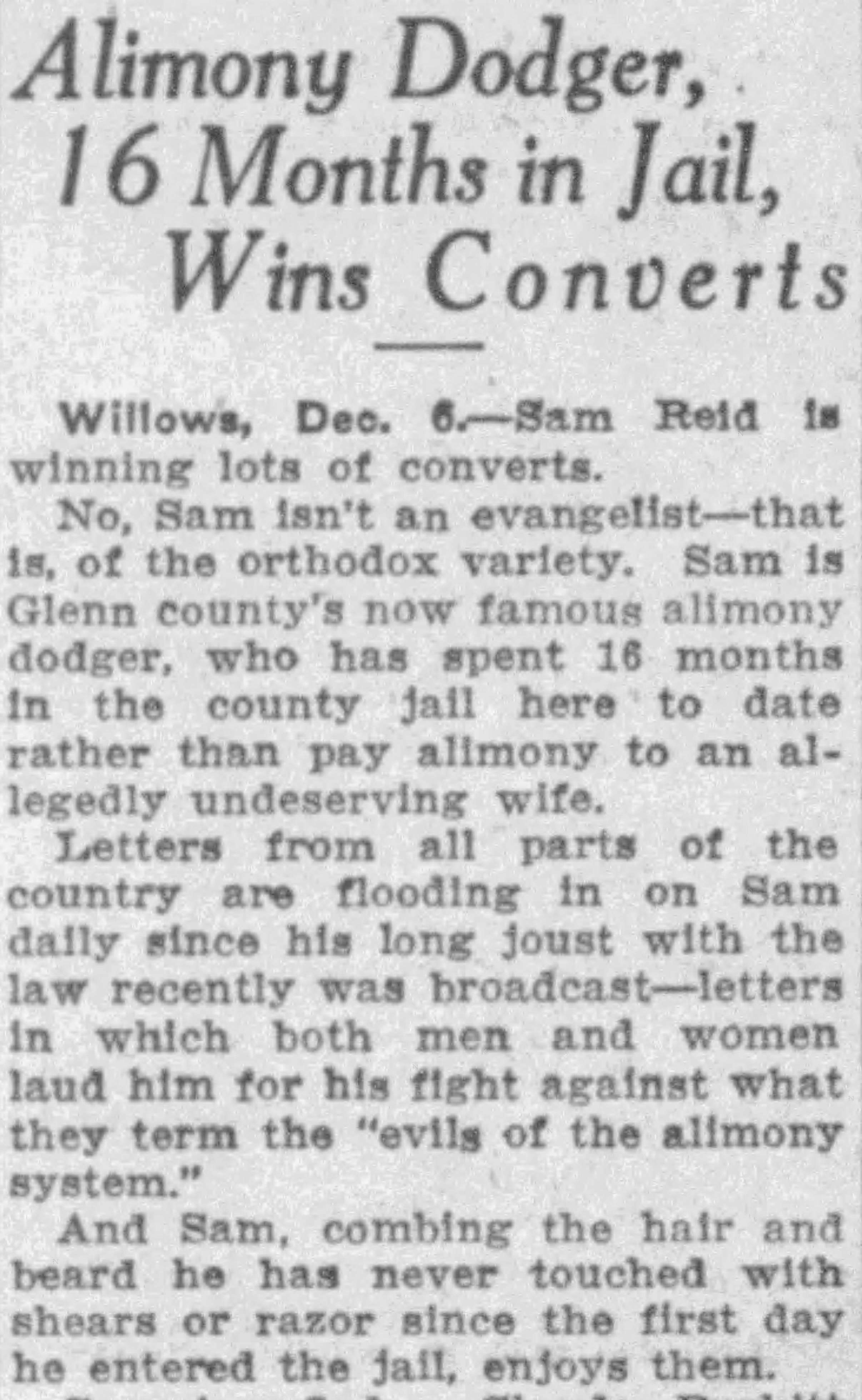
The story of Sam Reid aka Alimony Sam was a recent addition to my teaser file. I came across him in early November 2025 in the December 6, 1926 issue of the San Francisco Bullet.
It was a fairly easy story to track down. It had a definite beginning and end, the bulk of it taking place between early summer of 1925 and late fall 1928; it was geographically specific to one location in California; and, the popularity of Sam’s nicknames –”Alimony Sam”, “Alimony Martyr” and “Jail Hermit” provided unique search terms.
Plus, Sam’s story quickly caught fire, which meant there was more than enough material to mine, although much of it was syndicated and thus redundant. Oddly, I came across very few inaccuracies or exaggeration in those secondary reports, something I see a lot of in my work.
Let the research begin
My first goal of research was to get the story tied down with a timeline, so I worked through various newspaper databases, including the free California Digital Newspaper Collection, week by week beginning in 1925. One of the habits I have is to get as close to the original source as possible, so I started with local papers from Willow and Orland, then moved out to regional and state publications in Chico, Sacramento, San Francisco and elsewhere. Only then did I expand my search outside of California.
My next move was to figure out who Sam Reid was before he became Alimony Sam, and for that I needed to know more about his military career. Very little of that information went into the finished piece as I quickly realized that what he did in France during WWI was far less important to this story than who he did it with – the men of the 363rd Infantry.
And finally, I turned my attention to the other characters in Sam’s story, Phebe and her parents, little Zada, Walter Steuben, Sheriff Roy Heard, Judge Purkitt, Joseph M. Cahen and others. Again, this research was really about context not content, and little made the cut. That’s not at all uncommon to my process, btw. I cast my net wide, over-research and then allow everything I’ve come across to inform the work, whether that is a direct quote or a nuanced reference.
Here’s an example of how that worked in this piece. I came across a number of articles about Phebe and her family that predated her divorce from Sam, and there was a clear sense that her parents – likely her mother, were actively managing the narrative around their only child.
The notice of her first marriage to Walter, for example, refers to her as a “school girl” and the marriage as an “elopement.” Yet, Phebe was twenty when she married Walter, and, although the marriage was conducted by a Justice of the Peace, both her parents were in attendance. That’s a civil ceremony not an elopement – by definition “an act or instance of running off secretly, especially to be married,” but the framing likely mattered to a family whose social standing in the community would make anything less than an elaborate wedding and reception for their only daughter seem like either a show of weakness or snub. Instead of beating readers over the head with “proof”, I trusted them to read between the lines. I have some really smart readers!
As I always do, I also created a family tree for all the main players in this piece, and did research needed to put them and their story into the historical context of the day – in this case that included learning a bit more about something called the “alimony panic” which was taking over America in the mid-to-late 1920s.
In May of 1927, papers like the Philadelphia Inquirer dedicated full pages to the cause of so-called alimony payers, “husbands whom the Courts force to pay and pay and pay, and sometimes even go to jail for failing to meet their obligation,” and the organization they created – the Alimony Payers Protective Association.
The stated goal of the organization – an organization which fully embraced Sam and his cause – was clear:
“To protect the American home against unscrupulous lawyers out for fat divorces court fees and nothing else; to secure universal divorce and separation laws in all the States; to discourage the perjury, blackmail, conspiracy and extortion so frequent in litigation involving martial relations; and to do away with court discrimination in favor of women.”
To say there was both support and backlash in America to this group is an understatement!
Putting the pieces together
My first read of Sam’s story had me chuckling, and for good reason. He was a character. The long beard and then the fake beard, the knitting needles, his appearance at the reunion, leading the parade. The guy seemed to have a pretty good self of awareness and sense of humor.
Because of all that, I knew I had to make sure Sam was presented as a character and not a caricature, because behind all the laughs was a really tragic situation. A new marriage that fell apart, bitterness and immaturity and bull-headedness, a baby girl who spent what turned out to be a sadly short life without the presence of a father. Sacrifice for a principle, and, I would think, a lifetime of regret for what may have felt like a win, but was perhaps the greatest loss of Sam’s life.
How do you put that into what appears on the outside to be a light-hearted story about a goofy veteran with a bit of dramatic flair?
My answer was sticking to the facts, using Sam’s own words as often as possible, and not turning away from the hard parts. How’d I do?
There was a similar challenge in making sure I didn’t turn Phebe into a shrew, a spoiled princess bride who refused to grow up and leave her mother or face the challenges of married life.
That was a little harder, especially given the letters which Phebe and her mother had written to Sam after Walter’s suicide attempt, letters which I chose to reference rather than share in full.

Keep reading with a 7-day free trial
Subscribe to The Lost & Found Story Box to keep reading this post and get 7 days of free access to the full post archives.