

Margin Notes: How Horton Malone Got Too Much Publicity
An inside look at my approach and processes, and some of the challenges faced


Release date: February 3, 2026
Hi, and welcome to the Margin Notes on Horton Malone Got Too Much Publicity.

Today, I’ll be sharing a little about where I found this lost & found story, my over all approach to the story, some of the challenges I faced in piecing it together, and a bit of historical context that didn’t make it into the finished story.
So let’s, see what we find!
A story for all time
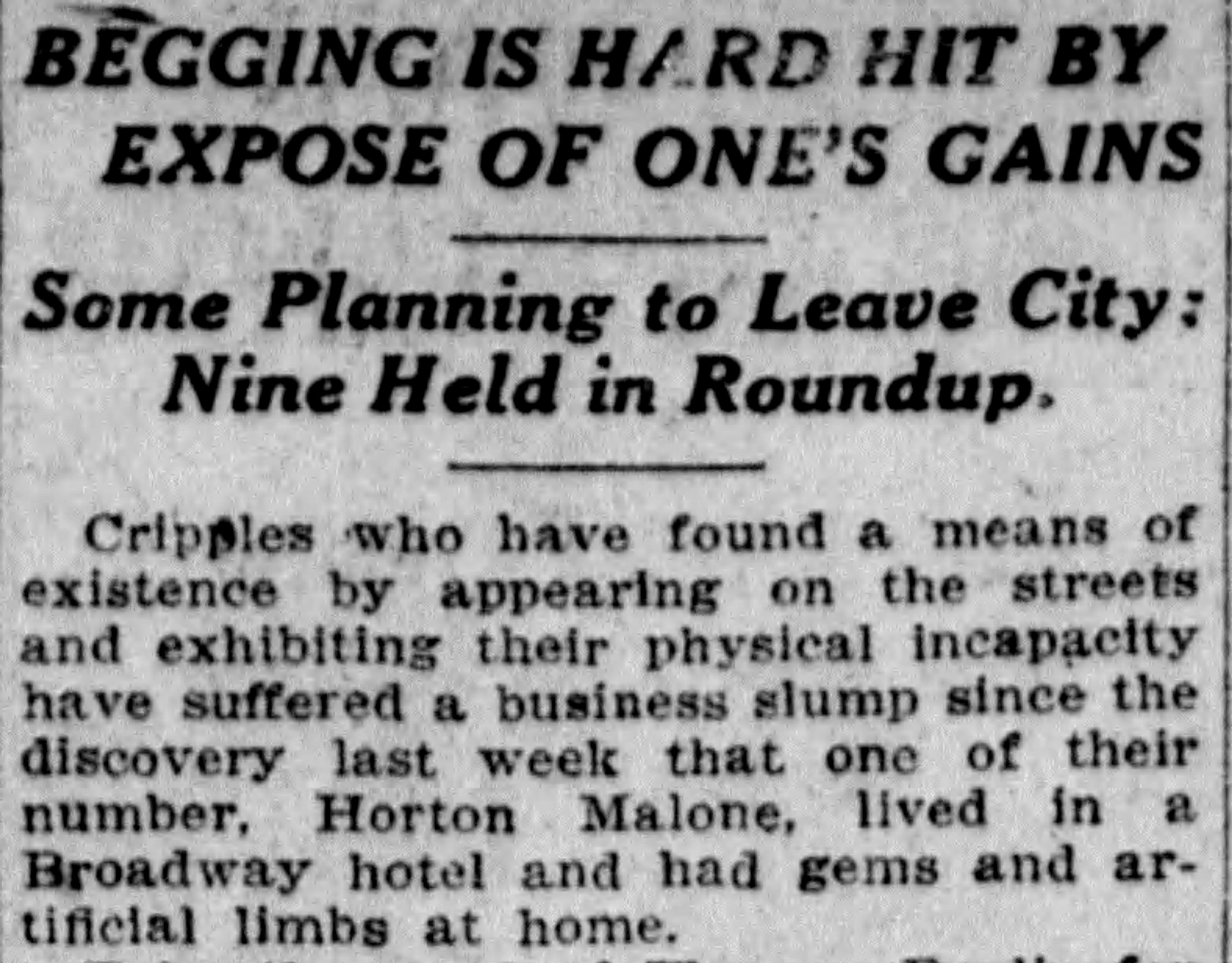
This was the headline and lead paragraph that got me curious about Horton Malone’s story. A “crippled” beggar living in a Broadway hotel and owning gems raises a lot of questions, right? Plus, it’s something we’re still talking about a hundred years later. Most of us have read or seen or otherwise come across stories about beggars and panhandlers and vagrants making bank by soliciting handouts from sympathetic, often well-meaning strangers. It’s so common to be a trope.
Let the research begin
Stories like Hortons, stories with a small “cast of characters” that take place over a well-defined timeline and in a single location are usually pretty easy to research. In the past, I’d normally just jump right into the newspapers, but I’ve been coming across a lot of “fake news” among the stories in my teaser files of late, so I’ve started verifying the “characters” through genealogical records before digging in any further.
In Horton’s case, everyone seemed legit. Horton himself appeared in federal and state census records beginning at age six and straight through to age 45, and his marriage to Sarah was also recorded. In the 1930 U.S. census he was listed as a salesman of dry goods, and in the 1932 NY Voter Registration records he listed his occupation as peddler, so I was pretty sure a) he was a real guy and b) I had the right Horton Malone. Whew.
As far as family background, Horton was born to Mack and Bessie Malone in Pomeroy, OH, a small village on the Ohio River. It’s possible his name came from the town’s history – a man named Valentine B. Horton was instrumental in bringing both mining and people to the community in the mid-1800s. When Horton was nine, his father died, and Horton and his mother moved in with his grandmother and her second husband. Bessie would live with them the rest of her life, taking over care of her stepfather after her mother’s passing in 1916.
Horton left Pomeroy sometime between then and 1920, when he showed up in Chicago and married Sarah, by most accounts, a year or two after he became legless. More about that a bit later.
Sometime after Sarah’s death in 1935, Horton returned to Pomeroy, and died there in 1945. His grave is located at the Minersville Hill Cemetery next to his grandmother’s.
Horton’s story broke on August 31, 1922, hitting the pages of no fewer than six papers in the New York City area, and every story had a different tone. Some were snarky, some were more reserved, but it was pretty clear they all recognized that Horton had hit a nerve. He was newspaper gold.
The Daily News, for example, published four distinct pieces in just three days.
Under the headline, “Rich Beggar Lives in Lap of Luxury: Legless Mendicant Buys Auto Out of Tin Cup”:
“His wife and two children share a luxurious apartment with Malone, but they, like his pair of splendid artificial legs, are but incidental furnishings. The most wonderful thing there is Malone himself, with no legs at all to speak of. He wears silk shirts, eats of the best, despises Andy Volstead, goes to the theatre, rides about in automobiles, has a chauffeur, money in the bank, wears diamonds and attends strictly to business.”
Under the headline, “Marshall Seizes Motor Car Owned by Wealthy Beggar”:
“As a beggar Malone wears ragged clothes, goes unshaven and impresses all who see him pushing his way about as a pitiful figure. But at the Marlborough Malone dresses well and puts on a big front when he goes out to his waiting dar to take air in Central Park with his wife as companion.”
Under the headline, “Sport Beggars Meet Weekly at Fast Poker Game”:
“Stumpy Horton Malone was a victim of T.M.P. - too much publicity. He pawned his diamond ring, took his automobile out of hock, shooed reporter, dodged photographers. And last night he checked out of the hotel with his titan-haired wife and mother-in-law
And finally the caption under a photo feature on Horton:
“The Committee on Beggars and Vagrancy is planning a campaign against rich beggars, which undoubtably won’t please Mr. Horton (Shorty) Malone.
In all, I found 17 unique 1922 articles about Horton Malone, most in New York and the surrounding area. There were also a number of syndicated pieces which appeared in papers across America, often weeks or even months after the event.
There were also four unique stories published in New York in 1927 when Horton was arrested and later sentenced to a month at the workhouse.
When I expanded my search beyond New England, I came across a couple stories out of Chicago – it turns out Horton had been there earlier, and was familiar to both the citizenry and law enforcement.
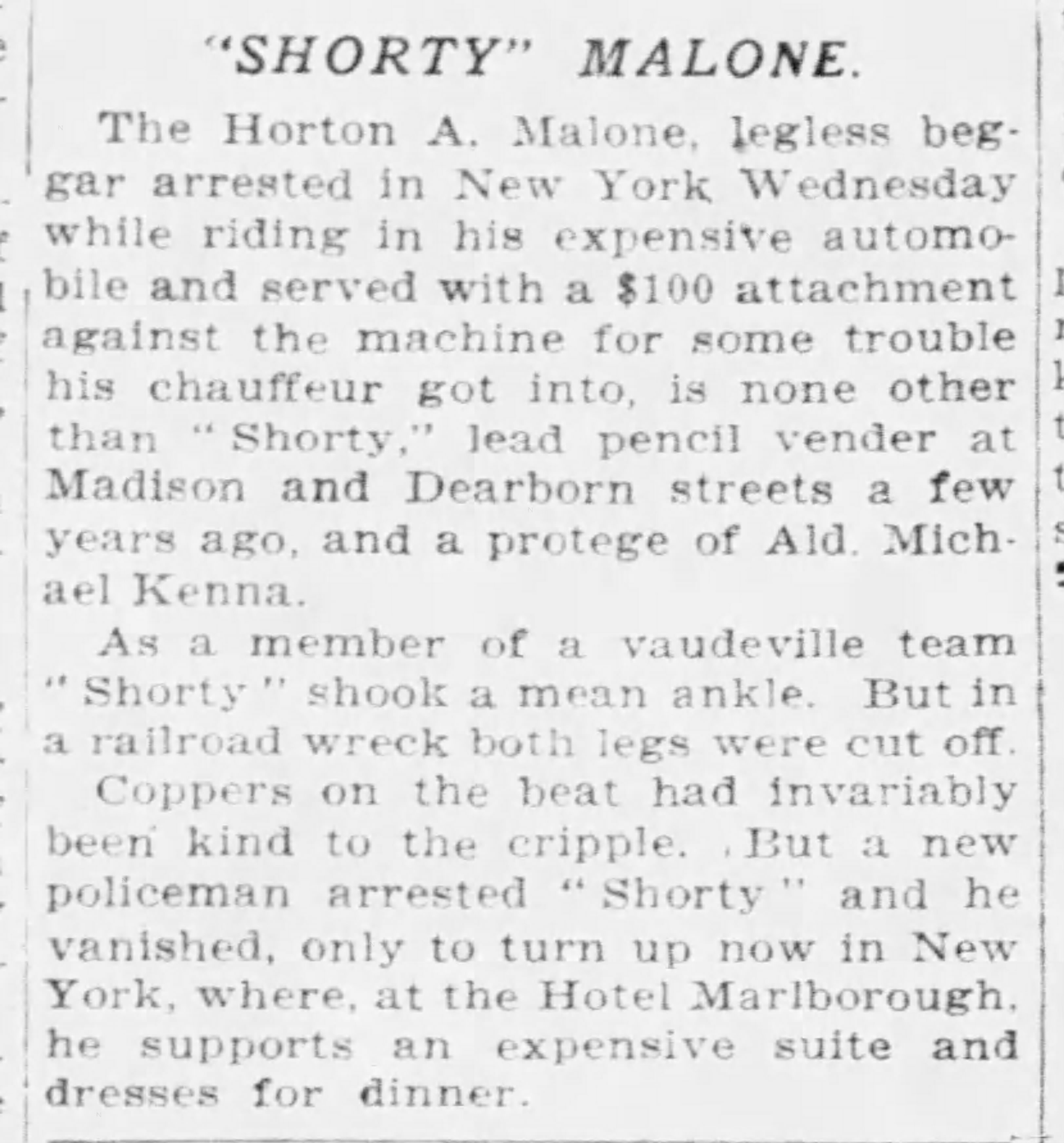
As often happens with a story like Horton’s – one that explodes onto the scene and then is quickly replaced by something else – there was a lot of redundancy and a lot of inaccuracy.
Here are two quick examples:
Several stories suggested Horton and Sarah had children, a few going so far as to say the children were in the room during interviews. No records exist to suggest the couple ever had children.
And at least two other stories stated Sarah’s mother was staying at the Marlborough with them, but also other family members, none of whom were ever named.
The biggest stories, however, were reserved for Horton and his legs.
How Horton lost his legs
Despite later accounts that he actually had full use of both his legs and trussed them up when he went to work to gain sympathy, there’s no doubt that Horton Malone was legless. How he got that way, however, is another story.
The most popular story of how it happened involves a tragic railroad accident. Perhaps in Ohio. Maybe in Michigan. Maybe in 1920, maybe around 1916. Horton’s wife, Sarah, and his mother-in-law, Mrs. Demko, both shared the railroad accident story with reporters in 1922, and it quickly became the go-to story to explain Horton’s condition. 1
But when Horton was arrested, convicted and sent to the county welfare house in 1927, his attorney, Joseph Wolfman, offered up a different version of events. And he offered them under oath.
In that version of events, Horton was employed in a West Virginia nitroglycerine factory in 1916, and lost both his legs in an explosion.
[Turns out there were a number of nitro explosions in WV between 1912 and 1918, nearly all in oil fields - although I did come across on that happened on a boat, but none that listed Horton by name or likely injury.]
Not that exactly how Horton lost his legs is all that important, but the storytelling around those events – and others, is, if not problematic, at least curious.
Take this bit of background information, again from Joseph, Horton’s attorney in 1927:
“There are certain very definite codes among the panhandlers, as I have learned from Malone and others whom I have defended. There are 15 or 20 in New York, and Malone is recognized as their chief. Every week they draw lots to decide what streets they shall work. If one of the ‘organization’’ gets in trouble, the first of his buddies to learn of it will come to his assistance. Malone made bail in ten minutes after his arrest. Arrangements are always made for the employment of able counsel, and the fee paid is seldom less than $500.”
Keep reading with a 7-day free trial
Subscribe to The Lost & Found Story Box to keep reading this post and get 7 days of free access to the full post archives.